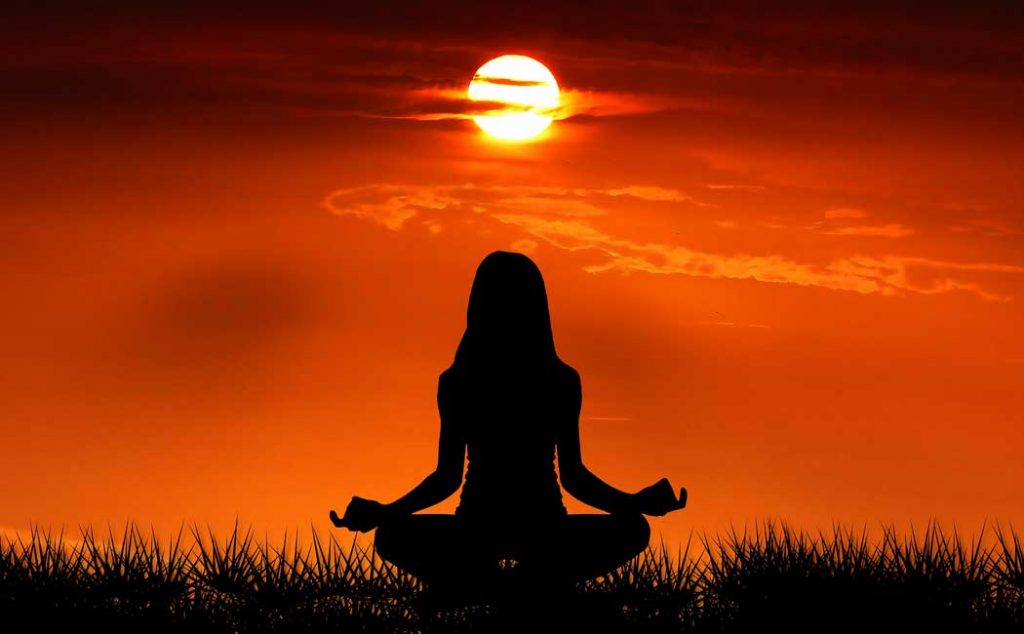
Every Neo-Gnostic aspirant should be familiar with the practice of meditation, and it is recommended that all students meditate daily. There are a number of misconceptions about meditation that I run into all the time, so I want to go over some of those and explain why they do not make sense. Then I want to share some insights from my own practice over the years.
It does not really matter that much what form of meditation you use. So if you have studied Zen or Vajrayana or some other system and those methods work for you, there’s no reason to stop doing them because you’re working from a Neo-Gnostic perspective. Just like Neo-Gnosticism, meditation can be completely nonsectarian.
Studies have found that while meditation has many cognitive benefits, the differences between the various systems are negligible and probably have more to do with individual differences. The point is that you do the practice, and that you do it regularly.
For those who have never studied meditation, the method I recommend learning is modern mindfulness meditation, a simplified non-sectarian system that is based on techniques akin to those of Zazen or Shamatha.
Here’s how you do it:
- Find a comfortable sitting position with your spine straight.
- Soften your gaze and look downward at about a 45-degree angle.
- Focus on your breathing, paying attention to how it feels as you inhale and exhale.
- When you catch your mind wandering, bring your attention back to the breath.
- Maintain this practice for about 20 minutes.
It sounds simple, but more people have trouble with it than you might think. Some people do have negative experiences when meditating and meditation teachers are sometimes not as honest than they should be regarding this possibility. I have found that some of these problems are due to false expectations, and others are due to poor instruction.
1. A lot of teachers will recommend Lotus or half-Lotus as a posture, which are great if you are flexible enough. Many Westerners have trouble with full Lotus, since you usually need to practice it as a younger person for it to be comfortable and it is not necessary. You can also do whatever you want with your hands – there is no prescribed position. The point is comfort – you are not trying to overcome a painful position, you are trying to relax. You do want your spine to be straight so that your body is upright and balanced, but other than that, the posture in which you meditate makes little difference. You can even sit up straight in a chair if works better for you than sitting on a cushion.
2. Buddhist teachers recommend the eyes-open approach, while Hindu teachers recommend eyes-closed. What researchers have found is that eyes-closed makes it easier to enter the meditative state, but eyes-open makes it easier to maintain meditative awareness in your daily life. I originally learned Shamatha from the Vajrayana tradition, which is eyes-open. And as I see it, Neo-Gnosticism is all about positive engagement with the external world, so it seems more appropriate to focus on integration of meditative awareness into your daily life. There also is the practical point that meditators do sometimes fall asleep, and eyes-open makes that less likely.
3. The focus on the breath is key. Try to let the sense of your breathing lightly and naturally fill your entire field of awareness. Do not worry if it feels like you are not “doing enough” and do not force it. Just do your best, and trust that you will get better at it over time. One of the biggest obstacles to successful meditation practice is expending a lot of effort worrying about whether or not you are doing it right. Focus on the breath means exactly that, and nothing else.
4. Your mind will wander during that practice – that is pretty much guaranteed. Do not, under any circumstances, view this as a failure. It is part of the method. This is the biggest roadblock I see with people trying to learn meditation – the idea that, somehow, the point of meditation is to “clear your mind,” and if you cannot do it perfectly and completely it means you are failing. This is nonsense promulgated by popular culture and people who do not understand the process.
People sometimes tell me that their mind wanders too much so they could never meditate. However, every time your mind wanders, you have an opportunity to bring it back to the breath. That is a better way of thinking about it. Your mind will become clearer if you do the practice, but it is not something that you can force. Think of time spent in meditation as acclimatizing yourself to the meditative state of mind. It has to be done regularly, and it just takes time.
5. Twenty minutes is about the ideal length for a meditation session. Obviously, if you are currently doing something else and it works for you, keep it up. But if you are just learning, try twenty minutes. The reason is that usually somewhere around 15 minutes, the state of your meditation will deepen. That is a good thing, and if you are only doing ten-minute sessions you will miss it. Magical work sometimes includes ten-minute eyes-closed sessions for astral work and pathworking, but those are not the same thing as sitting meditation. They serve two entirely different purposes.
Another practical recommendation is that you should get some sort of a timer so that you are not looking at the clock every couple of minutes. Especially when starting out, there is a strong temptation to do that and it breaks your focus every time. That is one reason people sometimes get better results if they meditate at a Zen center or some other establishment where they can do it as a group – because someone else is timing the session.
I generally do not recommend meditating much longer than twenty minutes. If you already are doing this and it is working well for you, feel free to keep doing it – but lengthy meditation sessions are not a goal to aim for. Students who pride themselves on how long they can meditate are missing the point. They invariably burn out, and anyway this should not be about “spiritual materialism” or feeling like you are better than “those losers” who only do twenty minutes.
Discipline is the real key to meditation, but not the discipline of pushing yourself hard from moment to moment. Rather, it is the discipline of maintaining your practice by meditating every day without fail. Twenty minutes a day for a year is far more effective than doing an hour a day for a month and then giving up. If you decide that you need to take a break from your practice, you can do that in a disciplined manner as well. Tell yourself that you will, say, take a break for seven days and then resume at that time. This is sometimes necessary, and you can still be disciplined about it by setting an intention in advance and sticking with it.
This brings me to one of the most important reasons that you might want to take a break. You should not try to meditate your way out of depression or an episode of any similar mental illness. I’m convinced that most of the problems that have been reported with mindfulness meditation are because people try to do just that. They start having negative feelings and decide – or are told by inept teachers – that more meditation is the only fix for them.
You should not meditate when you’re depressed, period. The reason is that the depressive state gets mixed up with the meditative state, and you wind up acclimatizing yourself to the wrong thing. That can make your depression worse even after you stop practicing, so be warned. If you suffer from periodic depression you can still practice, but make sure you do it when you are in a positive state of mind.
Meditation does reduce stress, and stress is a common trigger for mental illness, so you may find that your depressive episodes become less frequent as long as you maintain your practice. But with anything long-term, you probably will need to get some sort of psychological help before meditation will be of much use. Talk all you want about the malleability of the mind, but most mental illnesses have a physiological component that meditation has a hard time affecting.
Also, do not allow the fact that meditation has made your mind more resilient to become an excuse for putting up with people who want to exploit you. This is ridiculously common in the corporate world. Companies will sponsor “meditation classes” for employees because they reduce stress and are cheaper than paying out decent raises or keeping working hours at reasonable levels. By all means take the classes, but keep pushing for better pay and working conditions regardless of what meditation helps you handle. Point out that as an accomplished meditator, you can do more in less time and therefore deserve more money.
Meditation is the most basic mystical practice there is. The familiarity with the contents of your mind that meditation will help you develop is the foundation on which most of the more advanced Neo-Gnostic mystical practices rest. You need to know your own thoughts in order to help distinguish them from the communications of spirits, up to and including the Holy Guardian Angel. You always start in the meditative state when assuming a godform. The meditative state is the the “rest position” for astral work. And so forth.
So if you are in a healthy frame of mind and are not currently meditating, there is no time like the present to start. Just do it. It is simple and it should start making a difference in your life a lot sooner than you think.
Leave a Reply